What to Look for When Buying a Barrel Sauna in 2026 for Small Spaces
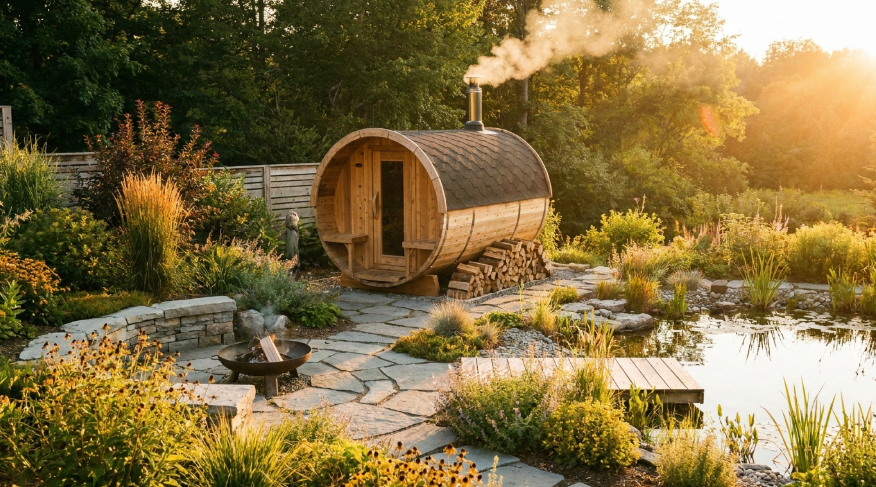
For a small yard or patio, the decisions that matter most are outside diameter versus available clearance, stave thickness and wood species, heater wattage relative to interior cubic footage, and whether the roof and cradle handle runoff without a drainage plan. A 6-foot diameter barrel is the standard pick for tight lots, needs roughly 7 to 8 feet of total clearance once the door swing is included, and typically pairs with a 4.5 to 6 kilowatt heater. Buyers who measure only the barrel itself and forget the swing radius and roof overhang are the ones who end up with a unit that does not actually fit.
How Much Clearance Does a Small-Space Barrel Sauna Really Need?
The diameter printed on a spec sheet is the barrel’s width, not the footprint it needs on the ground. A 6-foot model requires space for the door to swing open, which adds another 2 to 3 feet on that side, plus a few inches of roof overhang all around to keep rain off the staves. Most manufacturers recommend at least a foot of clearance behind and beside the unit for airflow and access to the electrical disconnect. On a narrow side yard, that easily pushes the real footprint to 8 or 9 feet across, so measuring the actual installation spot with those additions in mind, rather than trusting the diameter number alone, avoids an expensive surprise after delivery.
Which Wood and Stave Thickness Hold Up in a Compact Unit?
Smaller barrels are not built any differently on the inside than larger ones, so stave thickness and wood species matter just as much. Western red cedar and Nordic spruce resist warping and resin buildup better than most substitutes, and thermally modified hemlock is a common mid-price option that performs well once properly kiln-dried. Stave thickness in the 1.5 to 2 inch range is standard for retail barrel saunas and holds heat more evenly than thinner panels, which lose warmth faster around the curve of the barrel and force the heater to run longer to compensate. A listing that does not state stave thickness or wood species by name is worth skipping in favor of one that does.
What Heater Size Fits a Two or Three Person Barrel?
Heater output should track interior cubic footage, not the compact footprint. A 6-foot diameter barrel seating two or three people typically needs a 4.5 to 6 kilowatt electric heater, similar to a larger cabin sauna, because the curved roof does not actually reduce interior air volume by much compared to a boxy cabin of the same diameter. Buyers sometimes assume a smaller-looking barrel needs a proportionally smaller heater and end up with a unit that never reaches a comfortable temperature on a cold evening. Checking the manufacturer’s stated cubic footage against the heater’s rated kilowatts, rather than eyeballing the barrel’s size, is the more reliable method.
How Do Small Barrel Saunas Compare Across Retailers?
Pricing and included equipment vary a fair amount between sellers even for similar-sized units. Some list the heater and stones separately from the barrel shell, while others bundle a complete kit with the cradle, roof vent, and interior lighting included. Comparing full package contents rather than the headline price is the only way to know what a small-space barrel actually costs to get running; SweatDecks’ lineup is one place worth checking against other specialty sellers like Almost Heaven and Redwood Outdoors to see how kilowatt rating, stave thickness, and included accessories are listed side by side. A unit priced noticeably below similar models is usually thinner-staved, missing the heater, or both.
Does a Barrel Shape Actually Suit a Tight Lot Better?
The curved roof of a barrel sauna sheds rain and snow on its own, without a membrane roof or the seams a flat-roofed cabin needs, which is a real advantage on a small lot where drainage away from a fence line or foundation can already be tight. The tradeoff is usable floor space. A cube-shaped sauna of the same outside footprint offers more straight-wall bench room, since a barrel’s curved sides eat into headroom and shoulder space near the edges. For a yard where footprint is the binding constraint, the barrel usually wins; for a yard where floor space inside the unit matters more than the print on the ground, a cube-shaped cabin can be the better fit.
What Warranty and Delivery Details Matter Most for a Small Lot?
Warranty length is a reasonable proxy for how confident a maker is in its own build quality, and for a barrel sauna it is worth checking coverage on the shell, the staves, and the heater separately, since these are often warrantied for different periods. A structural warranty of five years or more on the barrel itself, paired with at least a two-year heater warranty, is a reasonable baseline among established brands; anything shorter, or a warranty that is not stated in specific terms on the product page, is worth asking about directly before ordering. On a small lot, delivery access is a separate concern that is easy to overlook. Freight carriers typically deliver a barrel sauna curbside on a pallet, and getting a several-hundred-pound crate from a driveway or curb to a tight side-yard installation spot without a gate wide enough for a hand truck or dolly can turn into its own project. Measuring gate widths and any narrow side-yard path before ordering, and asking the seller whether the unit ships fully assembled or in sections, avoids a delivery-day surprise on top of the installation planning already required for a small space.
Frequently Asked Questions
What diameter barrel sauna fits a small backyard? A 6-foot diameter is the most common choice for tight yards and seats two to three people. A 7-foot model needs roughly 8 to 9 feet of clearance once door swing and roof overhang are included.
Do small barrel saunas need less electrical work? Not necessarily. Heater sizing depends on interior cubic footage, so a compact two-person barrel with a standard electric heater usually still needs a dedicated 240-volt circuit.
Is a barrel sauna better than a cube sauna for small yards? A barrel sheds rain without a membrane roof and heats a smaller air volume. A cube offers more usable floor space per square foot of yard. The better shape depends on which constraint is tighter.
How much does a compact barrel sauna cost compared to a full-size one? A 2 to 3 person barrel typically starts a few hundred dollars below a 4 to 6 person model, though heater, stave thickness, and wood species move price more than diameter alone.
References
- Clinical Effects of Regular Dry Sauna Bathing: A Systematic Review, Evidence-Based Complementary and Alternative Medicine, 2018
- Does the Combination of Finnish Sauna Bathing and Other Lifestyle Factors Confer Additional Health Benefits? A Review of the Evidence, Mayo Clinic Proceedings, 2023
- Effects of heat and cold on health, with special reference to Finnish sauna bathing, American Journal of Physiology, 2018
By Nora Kessler